
Air tightness testing is a formal requirement under Building Regulations Part L (Conservation of Fuel and Power) and plays a direct role in demonstrating compliance through SAP calculations and Energy Performance Certification.
At completion stage, the programme is often under pressure. Final trades are finishing, clients are expecting handover, and building control sign-off depends on compliant documentation.
If air tightness testing is delayed, inaccurate or fails unexpectedly, it can affect:
- SAP final calculations
- Dwelling Emission Rate (DER) compliance
- EPC lodgement
- Mortgage approvals
- Handover timelines
Choosing the right testing provider protects your project at a commercially sensitive stage.
Here are nine questions worth asking before confirming your booking.
1. Are They Fully Accredited Under a Recognised Scheme?
In the UK, air tightness testing must be carried out by a tester registered with an approved scheme such as ATTMA (Air Tightness Testing & Measurement Association).
Government guidance under Approved Document Part L sets out the regulatory framework.
Accreditation is not a marketing label. It confirms that:
- The tester has passed formal competency requirements
- Equipment is calibrated to industry standards
- Testing methodology follows ATTMA Technical Standards
- Results are accepted by building control
Before booking, you should feel confident that the company can provide:
- Evidence of current accreditation
- Confirmation that the individual tester is qualified
- Properly formatted certification for compliance submission
Without verified accreditation, there is a risk that results may be challenged or rejected. That creates avoidable delay at the final stage of your build.
2. Do They Understand How Air Tightness Affects SAP and EPC Compliance?
Air permeability results feed directly into SAP (Standard Assessment Procedure) calculations, which determine whether a building meets its Target Emission Rate (TER).
SAP methodology is overseen by organisations such as the BRE Group.
An experienced testing company understands that:
- A poor air permeability result can affect DER compliance
- Failing to meet design targets may require recalculation
- In some cases, additional measures must be introduced
Testing is not simply about achieving “a pass”. It must align with the performance assumptions used in your SAP design stage submission.
A joined-up approach between tester and SAP assessor reduces the risk of last-minute compliance complications.
3. Do They Provide Structured Pre-Test Preparation Guidance?
One of the most common causes of failure is insufficient preparation rather than fundamental design flaws.
Professional testing companies should provide clear pre-test guidance so site teams know what must be completed before arrival.
This typically includes advice on:
- Sealing service penetrations (water, gas, electric, ventilation)
- Ensuring loft hatches are insulated and sealed
- Confirming windows and doors are fully installed
- Closing temporary openings
- Correct positioning of mechanical ventilation systems
On site, experienced testers often identify recurring issues such as:
- Incomplete mastic at skirting junctions
- Gaps around cavity closers
- Unsealed SVP pipe penetrations
- Poorly sealed extractor fan housings
Preparation support increases the likelihood of a first-time pass and reduces the risk of programme disruption.
4. What Testing Methodology and Equipment Do They Use?
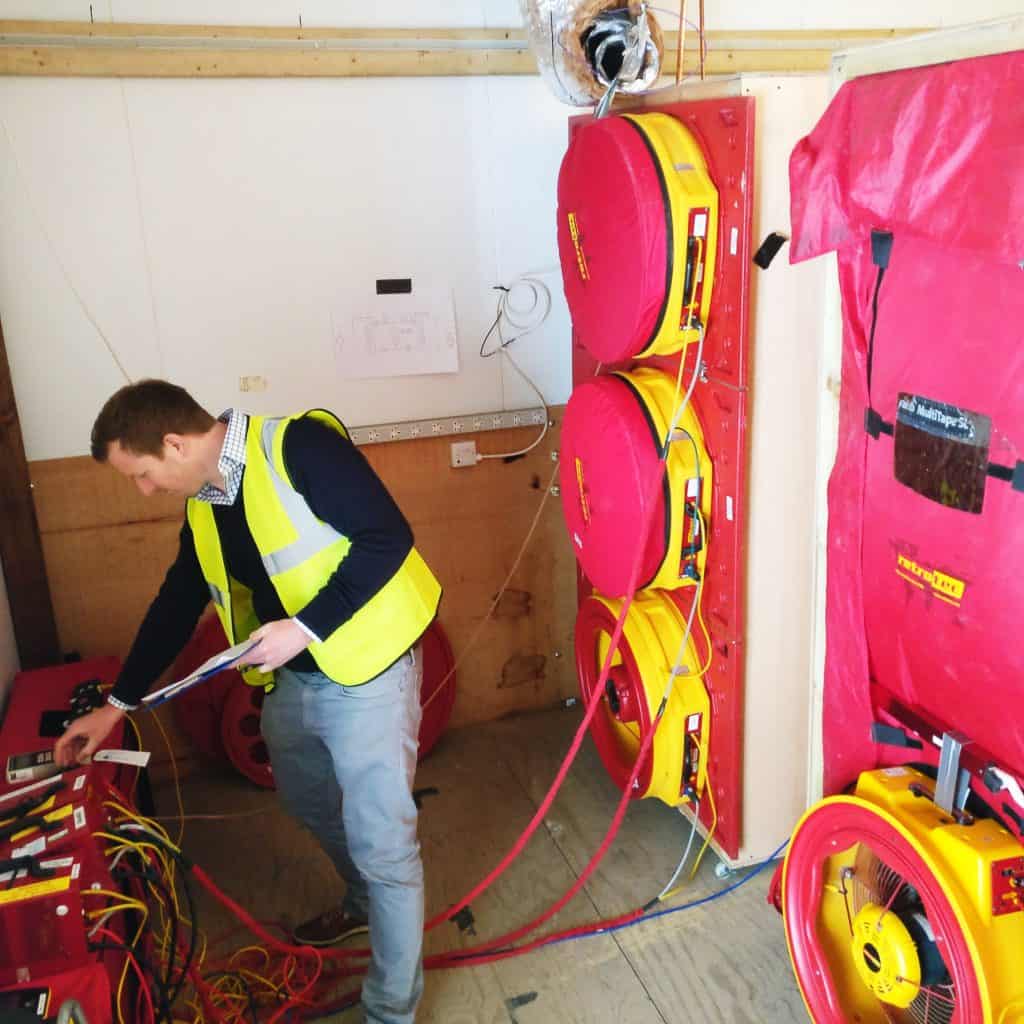
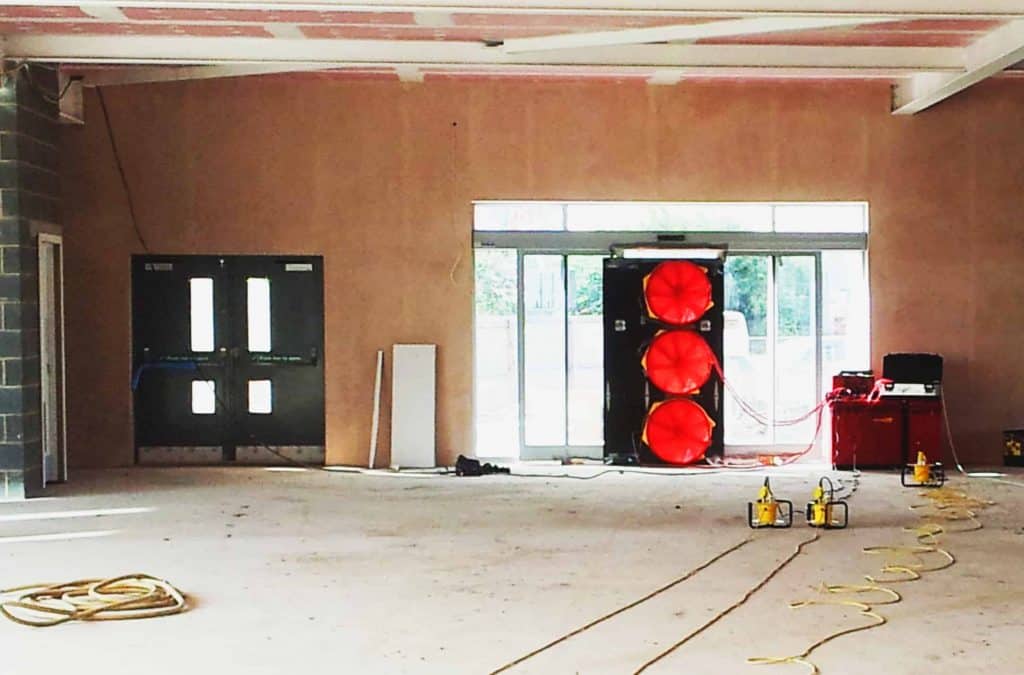
Air tightness testing is typically conducted using a blower door system, which measures air leakage by creating a pressure difference of 50 Pascals.
Testing should be carried out in accordance with ATTMA standards and include:
- Accurate building volume calculation
- Correct sealing of intentional openings
- Monitoring of environmental conditions
- Multiple pressure readings to ensure data reliability
If procedures are rushed or incorrectly followed, results may be unreliable.
This can lead to:
- False failure, triggering unnecessary remedial works
- Inaccurate reporting, risking compliance challenges
- Delays while clarification is sought
Accuracy protects your compliance position and ensures confidence in the certification issued.
5. How Quickly Is Certification Issued?
At completion stage, administrative efficiency becomes critical.
You should clarify:
- Whether certification is issued the same day
- How quickly digital copies are sent
- How results are shared with SAP assessors
- Whether data can be provided directly to building control
Even a short reporting delay can impact:
- EPC lodgement
- Building control approval
- Final payment milestones
- Client occupation dates
Professional testing providers understand the time sensitivity of this stage and issue documentation promptly and accurately.
6. What Support Is Provided If the Building Fails?
Failure does not necessarily indicate a major defect, but it does require a structured response.
A supportive testing company will:
- Identify likely leakage areas
- Explain findings clearly
- Provide practical remediation advice
- Offer realistic timeframes for re-testing
- Be transparent about additional costs
For example, leakage is often traced to:
- Junctions between walls and floors
- Service risers
- Roof-wall interfaces
- Party wall penetrations
Targeted sealing in these areas can resolve issues quickly when correctly identified.
Testing providers who simply report a failure without guidance may leave site teams uncertain about next steps, increasing programme pressure unnecessarily.
7. Can They Work Within Tight Construction Programmes?
Air tightness testing often occurs when multiple trades are completing final works.
A reliable provider should offer:
- Clear booking confirmation
- Reliable attendance
- Efficient on-site coordination
- Flexible scheduling where possible
If you manage housing developments or multiple plots, nationwide coverage can streamline coordination across projects.
Professional conduct on site also matters. Testing should be carried out with minimal disruption to finishing trades.
8. Do They Understand Different Project Types?
The testing approach varies depending on the building.
For example:
Single dwellings
- Typically straightforward testing environments
- Lower volume envelopes
Apartment blocks
- Compartmentation complexities
- Party wall considerations
- Phased plot testing
Commercial buildings
- Larger envelope areas
- Complex service penetrations
- Greater coordination requirements
Experience across different building types reduces uncertainty and improves planning.
You can explore broader compliance support via our
Building Compliance Services.
9. Do They Understand Sustainability and Long-Term Performance?
Air tightness is central to energy efficiency.
Improved airtightness contributes to:
- Reduced heat loss
- Lower carbon emissions
- Better indoor thermal comfort
- Reduced long-term energy demand
This aligns with the UK’s wider sustainability strategy outlined in the
UK Net Zero Strategy.
A testing company that understands performance, not just compliance reflects a deeper level of expertise and long-term thinking.
Why Choosing the Right Company Protects Your Project
Air tightness testing may represent a modest proportion of build cost. However, its impact at the completion stage is significant.
Poor preparation, inaccurate testing or slow certification can trigger:
- Labour downtime
- Remedial sealing costs
- Delayed sign-off
- Frustrated clients
At Air Tightness Solutions, we bring over 50 years of combined industry experience to every project. Our fully accredited team delivers precise, compliant air tightness and acoustic testing with professionalism, efficiency and attention to detail at every stage.
We work closely with developers, contractors and homeowners across the UK, providing clear guidance, accurate results and prompt certification to support smooth building control sign-off. Our approach is practical and solution-focused, helping you prepare properly, reduce risk and achieve compliance with confidence.
When your project is approaching completion, you need reliability, accuracy and a team that understands both the technical standards and the commercial pressures involved.
If you’re looking for experienced, accredited testing delivered efficiently and professionally, speak to Air Tightness Solutions today.
FAQs
Is air tightness testing mandatory for all new builds?
Yes, most new dwellings in England and Wales require testing under Part L unless covered by a specific exemption. Your SAP assessor or building control officer can confirm requirements for your project.
What happens if my air permeability result is higher than expected?
If your result exceeds the design target, your SAP assessor may need to revise calculations. In some cases, additional energy efficiency measures may be required to maintain compliance.
How do I know my building is ready for testing?
If all external envelope works are complete and service penetrations are sealed, the property is usually ready. A pre-test checklist from your testing company will help confirm readiness.
Can testing affect my EPC rating?
Yes. Air permeability figures are used in SAP calculations, which influence the final EPC rating. Better airtightness can contribute to improved energy performance outcomes.
Does mechanical ventilation need to be installed before testing?
Yes, ventilation systems should be installed and set correctly before testing. Temporary sealing of intentional openings must follow ATTMA guidance.
How accurate is a blower door test?
When conducted in accordance with ATTMA standards using calibrated equipment, blower door testing provides reliable and repeatable measurements of air leakage.
Can remedial sealing be carried out on the same day?
In many cases, minor sealing adjustments can be completed quickly. Larger issues may require coordination with relevant trades before re-testing.
Are there different requirements for commercial buildings?
Yes. Commercial properties often have larger envelope areas and may require different calculation approaches. Experienced testers can advise accordingly.
Is there a minimum air permeability target?
Targets vary depending on design and SAP modelling assumptions. Your assessor will confirm the required performance figure for compliance.
Should I coordinate air tightness and sound insulation testing together?
Yes, combining air tightness and acoustic testing can streamline compliance and reduce repeated site disruption.